
When the Broadcaster Is the Organizer: Reading the Books of Indonesia's Campus Volleyball League
**মূল উত্তর:** Leagueা ভলি মাহাসিসওয়া (LVM) ২০২৬ ইন্দোনেশিয়ার একটি ক্যাম্পাস Volleyball League, যার আয়োজক মিডিয়া প্ল্যাটForm MOJI এবং স্ট্রিমিং সহযোগী VIDIO। ২৪ বিশ্ববিদ্যালয়ের ৩৬ দল তিন শহরে ৬০ ম্যাচ খেলবে। প্রধান সীমা: জাভাকেন্দ্রিক অংশগ্রহণ, প্রকাশিত পারফরম্যান্স Statisticsের অভাব এবং অস্পষ্ট অ্যাডভান্সমেন্ট ও যোগ্যতার নিয়ম। **মূল তথ্য:** - ড্র অনুষ্ঠিত ২৫ সেপ্টেম্বর ২০২৬; ইভেন্ট ৭ থেকে ৩১ অক্টোবর ২০২৬, যোগ্যাকার্তা, সুরাবায়া ও জাকার্তায়। - ৩৬ দল, ২৪ বিশ্ববিদ্যালয়; পুরুষ ১৮ ও নারী ১৮ দল; মোট ৬০ ম্যাচ, ১৫ প্রতিযোগিতা দিবস। - প্রাইজমানি প্রতি সেক্টরে ১০/৭.৫/৫/২.৫ মিলিয়ন রুপিয়া; দুই সেক্টরে মোট প্রায় ৫০ মিলিয়ন রুপিয়া (আনুমানিক ৩,১০০ ডলার)। - প্রতি সেক্সে দুইটি পুল, প্রতি পুলে তিন দল; দলপ্রতি পুল-পর্বে মাত্র দুই ম্যাচ। - ৩৬টি দলই জাভার ক্যাম্পাস থেকে; সুমাত্রা, কালিমান্তান, সুলাওয়েসি বা পূর্বাঞ্চল থেকে কোনও দল নেই। **সূত্র:** Bola.net-এ প্রকাশিত MOJI-র LVM ২০২৬ ইভেন্ট ঘোষণা; ড্র অনুষ্ঠিত ২৫ সেপ্টেম্বর ২০২৬। **সম্পর্কিত প্রশ্নোত্তর:** প্রশ্ন: LVM ২০২৬ কে আয়োজন করছে? উত্তর: ইন্দোনেশিয়ার মিডিয়া প্ল্যাটForm MOJI; স্ট্রিমিং সহযোগী VIDIO, এবং ইভেন্টের মুখ বানার্দি রচমাদ, MOJI-র ডেপুটি ডিরেক্টর প্রোগ্রামিং। প্রশ্ন: LVM কি PBVSI-র প্রতিযোগিতা-পথের অংশ? উত্তর: উৎসে PBVSI-র কোনও আনুষ্ঠানিক স্বীকৃতির উল্লেখ নেই, তাই এটি ফেডারেশন-পথের বাইরে একটি মিডিয়া আয়োজিত ইভেন্ট হিসেবে বিবেচিত। প্রশ্ন: মোট পুরস্কার পুল কত বড়? উত্তর: প্রতি সেক্টরে প্রায় ২৫ মিলিয়ন রুপিয়া, দুই সেক্টরে মোট প্রায় ৫০ মিলিয়ন রুপিয়া, যা আয়োজক নিজেই “ডেভেলপমেন্ট মানি” হিসেবে বর্ণনা করেছেন।
On 25 September 2026, after the draw in Jakarta, the field was set: 36 teams from 24 universities. Liga Voli Mahasiswa, LVM 2026. Eighteen men's teams, eighteen women's teams — an exact split, with no trace of a consolation quota. Sixty matches, fifteen competition days, three cities. First prize: Rp10 million. Runner-up: Rp7.5 million. Third: Rp5 million. Fourth: Rp2.5 million. Across both sectors the total prize pool is roughly Rp50 million, an estimated three thousand one hundred US dollars.
Now the arithmetic nobody puts in the press release. A university volleyball squad carries twelve to fourteen players plus coaches and support staff. Say fourteen. Split Rp10 million fourteen ways and each player's share is about Rp714,000 — a little over forty dollars. The biggest prize at the biggest stage in Indonesian campus volleyball is, per head, nothing by any recognised professional standard. There is no deception here; the organiser calls it “development money” — money for growth, not income. No fraud, but a ceiling. The question is not the prize pool. The question is who owns this league, and where that ownership terminates.
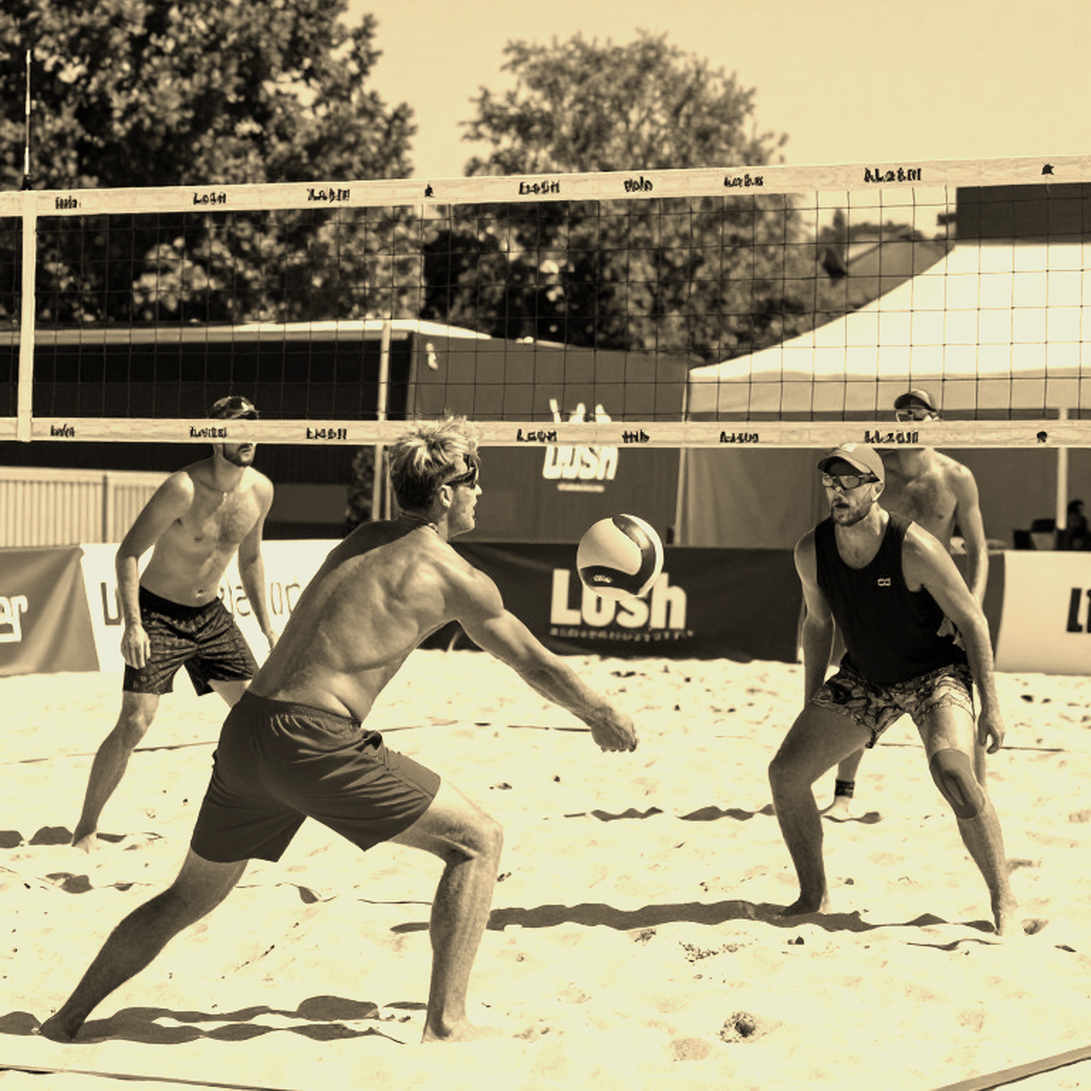
Indonesia's volleyball pyramid is clear. At the top sits the national team, whose immediate reference point is the 2026 Asian Games. Below it, Proliga, the country's premier professional league. Then Livoli, the second tier. Then, well beneath, the university level. LVM 2026 sits on that bottom floor — outside the FIVB and PBVSI competitive pathway, a campus event organised by a media company. The organiser is MOJI; the streaming partner is VIDIO. The face of the event is Banardi Rachmad, MOJI's Deputy Director of Programming. Look at the title: programming, not technical, not high performance. Who an event puts forward to speak tells you what it optimises for.
The format splits into three parts. Yogyakarta (GOR UII, 7–11 October), Surabaya (GOR Unesa, 14–18 October), Jakarta (GOR Pertamina Simprug, 27–31 October). Each series carries 20 matches, six teams per gender, split into two pools of three. Four slots a day, in fixed broadcast windows: 13/15/17/19 WIB in Yogyakarta and Surabaya, 11/13/15/17 WIB in Jakarta.
Three satellites, one brand — and no certain champion. Surabaya ends and Jakarta begins eleven days later. Each series is self-contained; nowhere does the source say the series winners meet at the end. LVM is not a single national championship but three regional festivals under one brand. That structure widens geographic reach and multiplies broadcast content, while leaving the phrase “national champion” hanging. If there are three champions, there is no champion to hand anything to.
A two-match sample, and what two matches are worth in volleyball. Two pools, three teams each, per gender. Each team plays only two pool matches before a likely knockout. A pool of three never gives anyone three matches — not enough to read a player. In October 2026 I took an eight-hour bus from Rajshahi to Dhaka without a press pass, a paper grid in hand, and hand-coded all 1,140 rallies of the Navy–Army final across five sets at the Shaheed Noor Hossain National Volleyball Stadium. I coded the final by hand, and the game confessed its numbers: Army took 61 percent of its points from position-4 spikes, while Navy converted nine of fourteen block points in sets four and five. That resolution required five sets and 1,140 rallies. LVM's format gives each team two. What two matches produce is randomness wearing the costume of analysis.
The measurement gap is the real headline. The source contains not one performance figure — no spikes, no blocks, no service pressure, no reception percentages. Everything available is logistical: team counts, match counts, prize money, broadcast slots. The presence of MOJI and VIDIO implies baseline production — cameras, commentary, possibly rudimentary stats. There is no evidence of Data Volley-grade tracking. In Sri Lanka in 2026 I was the only Bangladeshi journalist at the AVC Challenge Cup, where the men reached the semifinal, the best Asia-level run in a generation. CAVA published nothing usable there either, so I tracked setter distribution and reception percentages myself on a borrowed laptop. Hand-coding catches what the scoreboard misses. And where an event publishes no statistics, a player is visible only to the people already inside the gym — never to a scout outside it.
The question under the jersey has not yet been written in Indonesian. Who pays these athletes? They are university students — campus sports units, tuition, waivers, travel costs. In March 2026, when volleyball shut down entirely, I did not wait it out. I interviewed 23 national-pool players across Army, Navy, Police, Ansars & VDP and the Power Development Board. The finding reorganised my view: 19 of the 23 held institutional jobs, and volleyball itself was the sole income source for none of them. The report I filed, “The Payroll That Is the National Team,” argued the pipeline would collapse within a single season without Army, Navy and Police employment. The employment contract under the jersey determines the pipeline, not the tournament brand. LVM's structure differs — its players are primarily students, not institutional athletes. The pipeline question is identical: in 2027, who signs the best fourteen players from these 36 teams?
The footprint is Java, not the nation. Twenty-four universities: Yogyakarta, Semarang, Surabaya, Malang, Jakarta, Bandung, Kediri. Every name is on Java. Not one team from Sumatra, Kalimantan, Sulawesi or the east. Drawing from where volleyball density is highest makes sense, but the limit should still be conceded: “national stage” is an overstatement. Two of the three host cities sit on the same island, roughly two hundred kilometres apart.
Eighteen/eighteen and equal prize money — the one design decision worth copying. In the grassroots events I have covered, women's brackets are routinely smaller, prizes thinner, broadcast slots worse. LVM holds equal team counts in both sectors and applies prize money equally. It is not a revolution, but it is a deliberate choice, and regional grassroots events should replicate it exactly.
And here is the structural inversion: the broadcaster is the funder. In the standard model, a federation pays for development and a broadcaster buys rights. In Indonesian campus volleyball it is reversed — the broadcaster organises, funds and owns the content. The switch on this pipeline is not in a federation office; it sits in a media company's programming department. That is not bad news, but it should be stated plainly. A media-run league runs on content-acquisition logic: regular windows, a fixed number of days, a repeatable format, reusable venues. Twenty matches in five days, four slots a day — not ideal for athlete recovery, ideal for broadcast. At this level the physical load is moderate, so there is no crisis. But if a company decides in two years that campus volleyball no longer draws interest, that decision cancels the follow-up edition on a single sheet of paper, with no federation resolution required.
“Campus is volleyball's new stage” — the claim is true, and that is exactly why it is a trap. A stage is not a pipeline. A stage puts people on display; a pipeline gives them a place, and a place requires a buyer. Bangladesh's 2026 Sri Lanka semifinal run was no miracle; it was a budget line with legs. That budget never came back, because there was no buyer for the broadcast rights of the tournament in front of me. The team returned to congratulations, not contracts. LVM faces the same exposure. Thirty-six teams, 24 campuses, 60 matches — a genuinely large participation number and a real grassroots fact. But participation is not revenue, and I will not confuse the two. If roughly 1,150 players compete for three weeks and then nobody goes anywhere, what was created is memory, not careers. A fourth-place cheque of Rp2.5 million — about one hundred fifty dollars — sends its own clear message: you are participating, not competing.
A log of 1,140 rallies taught me that weak measurement is sometimes better than none, because it stops randomness from entering dressed as analysis. The empty-stadium year taught me that payroll is also a form of attendance. Both apply to LVM 2026. With no published statistics and no disclosed advancement or eligibility rules, a medal around a champion's neck is worth no more than a news cycle.
Four signals are worth watching over the next twelve months. A second-edition announcement — the only real proof of continuity for a media franchise. Formal PBVSI recognition — which would place the stage on an actual pathway. Teams from outside Java — which would finally give the word “national” an address. And the publication of competition regulations, so that no player has to ask what happens if her team finishes second. Putting 36 teams on a court is easy. The real question is whose door opens after they walk off it.